
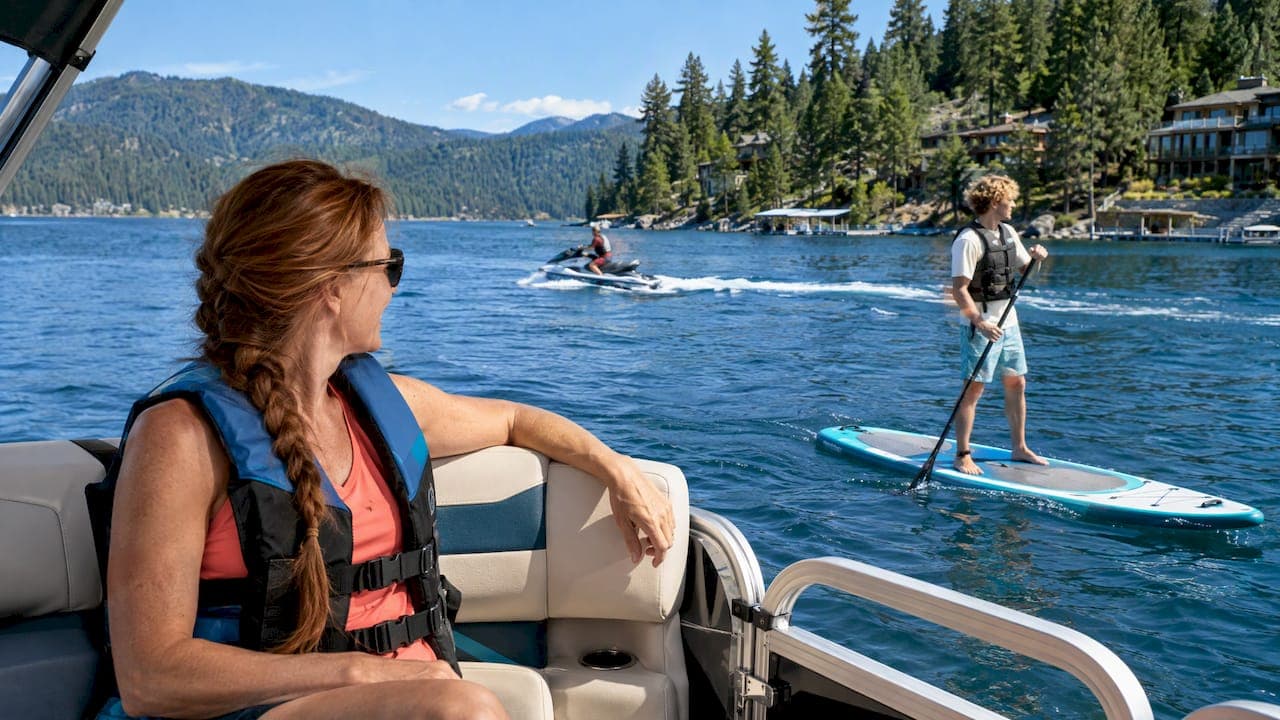
The main difference is this: a Type II life jacket is built to turn some unconscious wearers face-up, while a Type III is not, according to the BoatUS Foundation. Both are meant for calm, inland water where help is close. For most lake days, the better choice is the one that is Coast Guard approved for your activity, fits snugly, and that you will actually keep on.
TL;DR
- Type II (near-shore buoyant vest) can turn some unconscious wearers face-up. Type III (flotation aid) is not designed to.
- Both suit calm, inland water where a fast rescue is likely, and both count toward Idaho's requirement for a life jacket for every person aboard.
- Type III jackets are usually the more comfortable of the two, and some are marked for activities like water skiing.
- Fit matters more than the type: check the label for weight and chest size, and make sure the jacket does not ride up over your chin or ears.
- Kids have their own rules in Idaho and Washington, so check the age cutoff before you launch.
Table of Contents
- Type II vs Type III at a glance
- What a Type II life jacket does
- What a Type III life jacket does
- The newer "Level" labels
- Which one should you choose?
- Idaho and Washington rules for lake days
- How to check approval and fit
- Why wear one at all
- Ready for the lake?
- FAQ
- Sources
Type II vs Type III at a glance
| Type II (near-shore buoyant vest) | Type III (flotation aid) | |
|---|---|---|
| Designed for | General boating in calm, inland water where a fast rescue is likely | General boating in calm, inland water or where fast rescue is likely |
| Turns an unconscious wearer face-up? | Will turn some wearers | Not designed to |
| Typical feel | Bulkier, often a simple collar-style vest | Usually roomier and easier to move in |
| Activity markings | General boating | May be marked for water skiing, fishing, canoeing, kayaking and similar |
The descriptions of both types come from the U.S. Coast Guard's PFD selection guidance, and the face-up difference comes from the BoatUS Foundation.
What a Type II life jacket does
A Type II is called a near-shore buoyant vest. The Coast Guard describes it as intended for general boating in calm, inland waters where a fast rescue is likely. Its real selling point is the one in the table: it is built to turn some unconscious wearers onto their backs so their face is up.
That is a useful feature if you are boating with someone who may panic, tire quickly or struggle to stay upright. It is also a reasonable pick for a passenger on a pontoon who is not planning to swim much. "Some" is the important word. No jacket is a guarantee, so a Type II still has to fit correctly to do its job.
What a Type III life jacket does
A Type III is a flotation aid. It is made for the same calm, inland conditions, but it is not designed to turn an unconscious person face-up. The wearer needs to be able to keep their own head position in the water, and a rescuer should be close.
In return, Type III jackets tend to be the most comfortable to wear, which is why they are common among paddlers, anglers and people on the water for hours. The Coast Guard notes that a Type III may be marked for activities such as water skiing, hunting, fishing, canoeing or kayaking. That marking matters: the Oregon State Marine Board puts it plainly, saying to wear a jacket approved for the activity you are doing.
The newer "Level" labels
If you shop for a jacket now, you may see Levels instead of Types. The Coast Guard says wearable PFDs are categorized by performance Type and/or performance Level, and the Level number is the minimum buoyancy in Newtons. The page lists Levels 50, 70, 100, 150 and 275. A Level 70 device gives 70 Newtons (15.74 pounds) of buoyancy and is intended for people near shore or with help close at hand, as explained on the Coast Guard's life jacket wear page. Level 150 is for general application or foul-weather clothing.
You can still find both labeling systems on shelves, so read the tag rather than assuming.

Which one should you choose?
Think about who is wearing it and what they are doing.
- A non-swimmer or nervous passenger: lean toward the type that can turn a wearer face-up, and stay away from inflatables. The Coast Guard says inflatable life jackets and buoyancy aids are not appropriate for weak or non-swimmers.
- An active adult riding a jet ski or wakeboarding: pick a jacket marked for that activity. In Washington, each person on a personal watercraft or being towed must wear a Coast Guard-approved jacket designed specifically for that activity.
- Pontoon passengers and casual cruising: either type works for calm water. Comfort decides it, because the best jacket is the one you will actually wear, as the Coast Guard emphasizes.
- Kids: choose by weight and chest size on the label, not by the age printed on the box. Our life jacket fitting guide for adults and kids walks through it.
For more on matching jacket to activity, see our activity guide to life jackets for water sports.
Idaho and Washington rules for lake days
Most of our riders are on Lake Coeur d'Alene, Liberty Lake, Newman Lake and nearby water, so both states matter.
Idaho: all recreational vessels must carry at least one Coast Guard-approved Type I, II or III life jacket for each person on board or being towed. Children 14 or younger must wear an approved life jacket while underway on a vessel 19 feet or less. Both rules are in the Idaho boating handbook. So a Type II or a Type III satisfies the carriage rule.
Washington: every vessel must carry a properly fitted approved jacket for each person aboard. Children 12 and younger must wear one underway on vessels under 19 feet, unless they are in a fully enclosed area, according to Washington State Parks.
Rules change, so confirm the current version with the state agency before your trip. For local detail, we cover Lake Coeur d'Alene fines, stickers and PFD rules and Spokane-area life jacket laws with a parent fit checklist.

How to check approval and fit
The type only helps if the jacket is the right one for the person wearing it. Run through this before you push off:
- Find the approval label. The jacket must be Coast Guard approved, the proper size, in good and serviceable condition, and readily accessible, per the Coast Guard's guide.
- Read the size range. Check the manufacturer's label for user weight and chest size.
- Fasten everything. Buckle and tighten all straps so the jacket is secure, comfortable and adjustable.
- Do the lift test. Pull up on the shoulders or arm openings. The jacket should be snug enough that it does not ride up over the chin or ears, as the Idaho handbook describes.
- Try it in the water. Test it in shallow water under safe, supervised conditions and confirm your airway stays clear. The Coast Guard recommends this in its fit guidance.
For children, a guide to children's life jacket sizing covers reading the label, getting a snug fit and stopping a jacket from riding up. Our own piece on why life vest sizing matters makes the same point for the whole family.
Why wear one at all
Life jackets greatly improve the odds of surviving an incident, says the Oregon State Marine Board. Idaho's handbook adds that sudden immersion in cold water is one of the greatest hazards to boaters, and that everyone aboard should already have a jacket on. Inland lakes in this region can stay cold well into summer, and a fall from a jet ski or a tube happens in a second. Putting the jacket on at the dock is the only plan that works. If you are riding with us, read why to wear a life jacket on a jet ski, and if tubing is on the plan, see tubing safety on Idaho lakes.
Our take on life jackets
We rent Yamaha WaveRunners, ski boats and pontoons around Spokane Valley, Liberty Lake and Coeur d'Alene, and the most common question at the dock is not about speed. It is whether everyone's jacket fits.
Our view is simple. The type matters, but a correct fit matters more. We include safety equipment with our rentals so your group can get on the water without hunting for gear, and our team is happy to help you size jackets for adults and kids before you leave.
We would rather spend five minutes adjusting straps on the dock than have anyone spend their lake day in a jacket that rides up or feels too tight to keep on. A comfortable jacket stays on, and a jacket that stays on is the one doing its job.
Life is better on water.
Ready for the lake?
We offer jet skis, ski boats, pontoon boats, paddleboards and water toys, with safety equipment and flexible rental periods, near Spokane Valley, Liberty Lake and Coeur d'Alene. Jet ski rentals are published at $250 to $425, with additional hours at $75 per hour and a $500 damage deposit per jet ski. Boats carry a $1,000 damage deposit, and wakeboards and tubes are $50 each.
See Liberty Lake jet ski rentals, compare options on our rental prices page, or choose between a jet ski and a pontoon boat if you are planning a family outing.
FAQ
Can I use a Type III life jacket instead of a Type II?
In Idaho, a Type I, II or III counts toward the requirement of one approved jacket per person aboard. The difference is performance: a Type II can turn some unconscious wearers face-up and a Type III is not designed to. Pick based on who is wearing it and what they are doing.
Which is more comfortable, Type II or Type III?
Type III jackets are generally the more comfortable of the two, which is why they are common for active use. Comfort matters because the Coast Guard stresses that the best jacket is the one you will actually wear.
How do I know if a life jacket is Coast Guard approved?
Look for the approval label on the jacket, and check that it lists the user weight and chest size that match the wearer. The jacket should also be in good, serviceable condition and easy to reach.
Do kids have to wear a life jacket on the lake?
Yes, in both states. Idaho requires children 14 and younger to wear an approved jacket while underway on a vessel 19 feet or less. Washington requires it for children 12 and younger on vessels under 19 feet, unless they are in a fully enclosed area.
Sources
- Types, BoatUS Foundation
- PFD Selection, Use, Wear & Care, U.S. Coast Guard
- Life Jacket Wear, U.S. Coast Guard boating safety
- How to choose the right life jacket, U.S. Coast Guard
- Idaho Boating Laws handbook
- Wear a Life Jacket, Washington State Parks
- All About Life Jackets, Oregon State Marine Board