
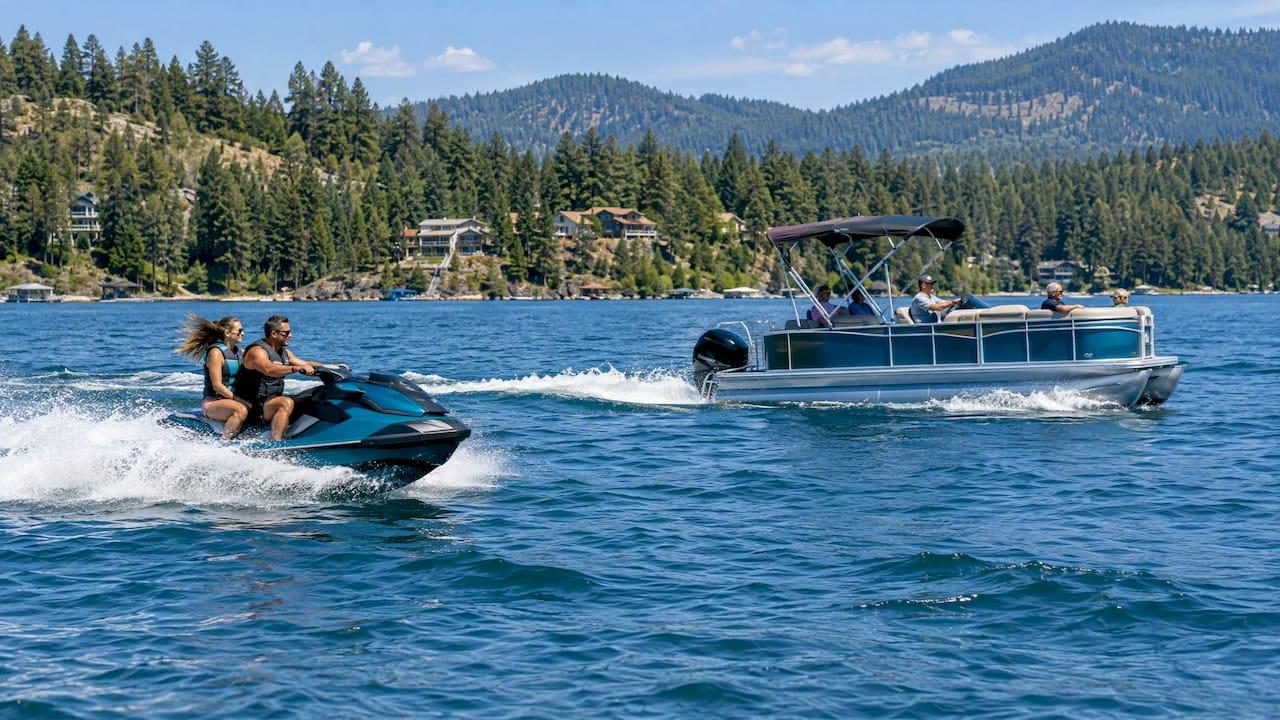
When you meet another boat on a lake, steer to the right, give the other boat plenty of room, slow down and make your move early and obvious. If you are the one overtaking, you are the one who keeps clear. That covers most passes on Lake Coeur d'Alene, Liberty Lake and Newman Lake, and the rest of this guide explains the details so a first-time renter can handle them calmly. If you are renting a jet ski or boat from us, these are the habits we want you to take onto the water.
TL;DR
- Head-on: both boats turn to starboard (right) and pass left side to left side.
- Overtaking: you can pass on either side if it is safe, but the boat coming from behind must stay clear.
- There is no fixed "safe distance" in the rules. Pass wide, slow and early, and keep your wake small.
- Anglers, swimmers, paddlers, anchored boats and docks get extra room and a slow speed.
- Know your local lake rules: Lake Coeur d'Alene is among Idaho waters that may be federally controlled, and Washington lakes are enforced by state and local authorities.
Table of Contents
- Right of way is really about responsibility
- Meeting head-on: keep right
- Overtaking: which side is correct?
- How much room is enough?
- Extra courtesy around anglers, swimmers and paddlers
- Local rules on Coeur d'Alene and Spokane-area lakes
- Ready for your own lake day
- Our point of view
- FAQ
- Sources
Right of way is really about responsibility
Boaters say "right of way" all the time, but the U.S. Coast Guard's Navigation Center explains that the navigation rules assign responsibilities rather than a general privilege. Every operator has to take precautions to avoid a collision, even when the other boat is technically the one that should yield. Idaho's boating handbook says the same thing in plain terms: both operators are responsible for avoiding collisions, with good seamanship, a sharp lookout and a safe speed and distance.
In practice, one boat is the give-way boat, which must change course or speed early, and the other is the stand-on boat, which holds a steady course and speed so nobody has to guess. The stand-on boat still watches for trouble. If the give-way boat does not act, you act too.
The Coast Guard also lists who a power-driven boat must stay out of the way of: vessels that cannot maneuver well, sailing vessels, and boats that are fishing. On a lake, that means you give way to sailboats and to anglers, and you do not expect them to dodge you.

Meeting head-on: keep right
When two powerboats approach bow to bow, Idaho's handbook directs both operators to alter course to starboard so they pass port to port. It works like passing cars on a road: each of you moves to your right and passes left side to left side.
Two things make it smooth:
- Turn early and make it obvious. The Coast Guard notes that operators must make course or speed changes clearly apparent. A tiny nudge is easy to misread.
- Ease off the throttle. A jet ski or ski boat throws a wake that rocks smaller boats well after you've gone by.
Port and starboard in one second
Face the front of the boat (the bow). Port is left and starboard is right. A handy trick is that "port" and "left" both have four letters. Starboard, then, is right.
Overtaking: which side is correct?
This is the question people search most. In U.S. waters, the Coast Guard's boating guide says the overtaking vessel may pass on either side and is the give-way vessel. So there is no single correct side. The faster boat comes from behind, chooses the side with more open water, and stays clear until it is well ahead.
On inland waters, the same guide describes sound signals for this: one short blast to pass on the other boat's starboard side, two short blasts to pass on its port side, and the other boat answers if it agrees. Most recreational lake traffic does not use horns, so the signal that counts is a clear, early move and, if you like, a wave. Do not cut across a boat's bow after you pass. Wait until you have a generous gap.

How much room is enough?
There is no number you can count on. The Coast Guard's Navigation Center says the rules do not set a specific safe passing distance or safe speed. Operators must act early and leave enough room to pass safely. For a rental guest that translates into simple habits:
- Pass wide, not close, even on a big lake like Coeur d'Alene.
- Throttle down before you reach the other boat, not as you pass it.
- Keep your wake low near anything that is stopped, small or crowded.
- Do not weave, swerve or cut in front of another boat.
A lookout matters as much as the passing move itself. These boat safety guidelines stress watching ahead, speed and distance, and that applies equally on a mountain lake.
Extra courtesy around anglers, swimmers and paddlers
Most lake complaints are about wake rather than collisions. Minnesota's natural resources agency sums up the unwritten rules well: control your wake around boaters, swimmers, anglers and shorelines, obey slow-no-wake areas, and enter anchorages slowly without disturbing boats already there. Those habits carry over to every lake around Spokane.
- Anglers: pass slowly and well away from fishing boats.
- Swimmers and paddleboarders: stay far away and keep your speed low. A wake that is a ripple to you can tip a paddleboard.
- Anchored and beached boats: slow down a long way out. If you are heading to a swim spot, our guide on how to beach a boat safely walks through it.
- Docks and ramps: approach slowly and be ready before you pull up. See our boat ramp etiquette steps.
- Jet skis: the same passing rules apply to you, and your agility is no excuse to get close. Our jet ski etiquette rules cover wake jumping, circling and more.
Local rules on Coeur d'Alene and Spokane-area lakes
Who enforces the rules depends on the water. Idaho Parks and Recreation says Lake Coeur d'Alene is among Idaho waters that may be federally controlled. On the Washington side, state park rangers, Fish and Wildlife agents and local authorities enforce boating laws, while the Coast Guard handles federally controlled waters.
Speed and wake limits differ lake to lake and by shoreline, so check before you go. Our pages cover the details for each: Spokane lake speed limits and no-wake zones, Lake Coeur d'Alene rules, and Spokane River jet ski rules and closures. If you are new to renting, start with our lake rental tips for first timers and the required safety equipment checklist.
Ready for your own lake day
We rent Yamaha WaveRunners, ski boats, pontoons, paddleboards and water toys for lakes around Spokane Valley, Liberty Lake and Coeur d'Alene, with safety equipment included in the experience. Jet ski rentals are listed at $250 to $425, with additional hours at $75 per hour and a $500 damage deposit per jet ski. Boats carry a $1,000 damage deposit. Wakeboards and tubes are $50 each. See current options on our rental prices page or book a jet ski at Liberty Lake.
Our point of view
Passing well is mostly about slowing down early and being predictable. Whether you are on a jet ski, a ski boat or a pontoon, the guests who have the best day are the ones who ease off, give anglers and paddlers space, and keep their wake small.
We want every guest to have a safe, fun, hassle-free day, and that is why we rent clean, well-maintained Yamaha watercraft and make the booking simple. A relaxed rider who knows the basics enjoys the lake more.
Life is better on water.
FAQ
Are you supposed to pass boats on the left or right?
When meeting head-on, both boats steer right and pass left side to left side. When overtaking, you may pass on either side if it is safe, and the overtaking boat must stay clear.
Who has the right of way on a lake?
Officially, the rules assign responsibilities rather than a privilege. One boat gives way and the other stands on, but both must avoid a collision. Power-driven boats yield to sailboats and fishing boats.
Do I need to sound a horn when I pass?
The Coast Guard describes one short blast and two short blasts for overtaking on inland waters. Most casual lake traffic relies on early, clear moves instead, but you should know what the signals mean.
How close can I pass another boat?
The rules give no fixed distance. Pass wide, slow down early and keep your wake small, especially near anglers, swimmers, paddlers and anchored boats.
Sources
- Navigation Rules Frequently Asked Questions, U.S. Coast Guard Navigation Center
- Navigation Rules FAQ, speed and distance
- Idaho Boating Laws handbook
- Idaho Parks and Recreation, Boating
- U.S. Coast Guard boating guide on markers and rules
- Port and Starboard: How to Remember the Difference
- Minnesota DNR, Boating Etiquette
- Washington State Parks, Recreational Boating Laws and Regulations