
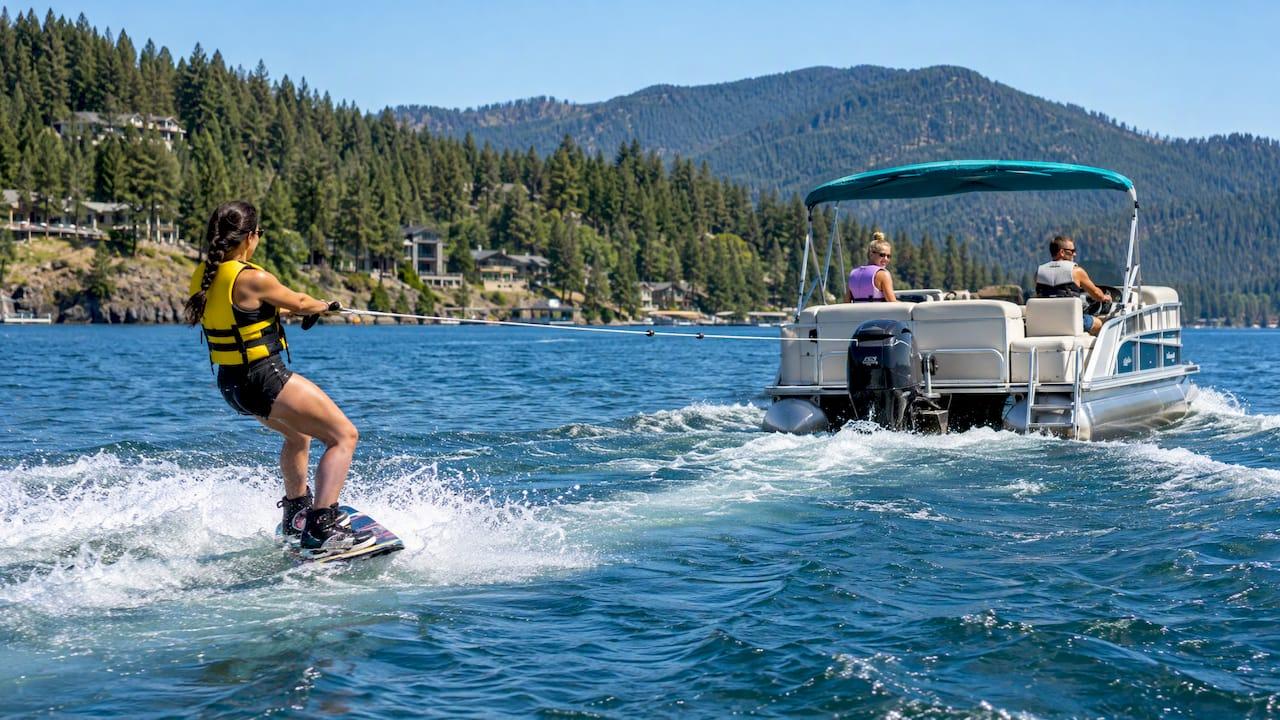
Yes, you can wakeboard behind a pontoon. It works best for beginners and casual riders, on a boat with enough engine, a proper tow point and a calm stretch of water. A pontoon's modest wake is a gentle place to learn to get up, stand and carve. Big jumps are a different story. Below you'll find the horsepower, speed, rope length and safety steps, plus the local rules on lakes near Spokane and Coeur d'Alene.
TL;DR
- A pontoon can pull a wakeboarder. Expect a small wake that suits learning, not big air.
- Engine size matters most. Sources commonly point to 115 hp as a floor for basic riding and 150 hp or more for comfort with a full boat.
- Tow at roughly 18 to 23 mph for adults and about 12 mph for small kids, with a 65-foot rope to start.
- Use a spotter, accelerate slowly and tie the rope only to a real tow point.
- Check lake rules first. Wake limits and no-towing zones apply on parts of the Spokane and Coeur d'Alene waterways.
Table of Contents
- Why a pontoon can work for wakeboarding
- How much horsepower you need
- Speed, rope and tow point
- Pontoon vs. a purpose-built boat
- Safety: driver, spotter and rider
- Rules on Spokane and Coeur d'Alene waters
- Plan your lake day with us
- FAQ
- Sources
Why a pontoon can work for wakeboarding
A pontoon is a comfortable, stable platform, and that helps a first-timer. Bennington Marine notes that a pontoon's smaller wake suits learning to start, stand and cross wakes, while experienced riders get less air. Plenty of friends and family can ride along, which makes it a social way to try the sport.
If you're deciding between boat types for a trip, our guide to renting a pontoon for the lake day covers what the format does well.
The tradeoff is simple. A pontoon sits high and flat, so the wake is small. That is friendly for beginners and a limit for jumpers.
How much horsepower you need
No single number covers every boat. Length, tube count and passenger load all change the answer. Published guidance from boat dealers and blogs runs like this:
| Setup | Typical guidance |
|---|---|
| 18 to 20 ft pontoon | 75 to 115 hp for light loads and calm water |
| 20 to 24 ft pontoon | 115 to 200 hp for general towing |
| 24 to 28 ft tritoon | 200 to 300+ hp for a better wake |
Those ranges come from a pontoon horsepower reference. River Valley Marine says 150 hp or more is ideal for wakeboarding regardless of how many people are aboard, and that riders need about 21 mph or more, usually closer to 26 or 27, for waterskiing and wakeboarding. Dealer guidance on adult wakeboarders is lower, so treat speed figures as a range and let the rider's weight guide you.
Two practical points:
- Load matters. A pontoon that pulls one rider with two passengers can struggle with a dozen people aboard.
- Tritoons help. A third tube gives more stability and lift, so planing is quicker. Slow acceleration is the usual pontoon complaint, and a tritoon eases it.
If you want a deeper look at engine size for towing, see how much ski boat horsepower you actually need.
Speed, rope and tow point

The WSIA Towed Water Sports Handbook recommends 12 mph for first-time kids and 18 to 23 mph for adults, with a 65-foot line for beginners and 75 to 80 feet for more experienced riders. Bennington adds that heavier riders and adults need roughly 15 to 20 mph to get up.
Putting that together:
- Start slow. Idle until the rope is tight, then add throttle smoothly. Abrupt starts yank riders forward.
- Hold a steady speed once up. Beginners usually settle around 18 to 20 mph. Move up in small steps.
- Begin with a longer rope. About 65 feet is the beginner standard. Shortening it later gives more leverage once the rider is stable.
- Use a real tow point. A ski tow bar or arch is the right anchor. Never tie to a railing or cleat, which isn't built for towing loads.
To get a bit more wake, passengers can sit toward the stern. Do this within the boat's posted capacity, and keep ballast to approved water-filled bags. The WSIA handbook warns against sinking ballast such as concrete or lead.
Pontoon vs. a purpose-built boat
A wake boat is built to push water. Its inboard engine, ballast tanks and tower shape a large, clean wake. A pontoon is built for comfort, so you give up some wake size and acceleration. Serious wakeboarders who want to jump typically look to a dedicated boat, and we cover that in what a wakeboat is.

For a first day, the difference may not matter. A beginner needs a slow pull and forgiving water more than a huge wake. If you plan to progress, our beginner's guide to wakeboarding behind a ski boat walks through the next step.
Safety: driver, spotter and rider
Three jobs make a pontoon session safe:
- Driver: watch the path ahead and the speed. Make gentle, wide turns, and slow down if the rider looks like they're losing control.
- Spotter: a second person who faces the rider the whole time and signals the driver. The WSIA handbook says the observer should always face the rider so the driver can focus on the water.
- Rider: wear a life jacket, and agree on hand signals before leaving the dock.
Propellers deserve respect. The Coast Guard warns that a typical three-blade prop at 3,200 rpm can strike 160 times in one second. Shift to neutral and shut the engine off whenever someone is in the water near the boat, and bring a fallen rider alongside on the driver's side so they stay in view.
Starting kids? Keep the first sessions short and slow. If you're helping young children build confidence in the water first, these swim board exercises for kids are a gentle way to build comfort before a tow day.
Rules on Spokane and Coeur d'Alene waters
Local rules can decide where you can ride, so read them before you launch. Kootenai County's boating brochure lists several that matter here:
- On the Coeur d'Alene River, towing such as waterskiing and tubing is not permitted.
- The Spokane River is a no-excessive-wake zone, and the brochure counts wake enhancement by ballast or uneven loading as excessive wake.
- Speeds must be 5 mph (no wake) within 100 feet of shoreline, a dock, a pier or a person in the water.
- Children 14 and under must wear a life jacket on vessels 19 feet or less.
All of that comes from the Kootenai County safe boating brochure, published in 2021, so confirm current rules with the county or Idaho and Washington boating authorities before you go. For Spokane-area lakes, our Spokane lake speed limits and no-wake guide breaks down the distances renters need to know. For the tow-sport basics on Idaho lakes, see our tubing safety guide.
Our take on pontoons and wakeboarding
We rent pontoons, ski boats, jet skis, paddleboards and water toys around Spokane Valley, Liberty Lake and Coeur d'Alene, so we hear this question often. Our view: match the boat to the day. A pontoon is a relaxed, roomy way to get a group on the water, and it gives first-timers a gentle introduction.
When a rider wants a bigger wake and a quicker pull, we point them to a ski boat. We aim to keep our Yamaha watercraft clean and well maintained, with safety equipment included, so the day starts easy.
Tell us who's riding, how many people are coming and which lake you plan to use. We'll help you pick the setup that fits.
Life is better on water.
Plan your lake day with us
If you'd rather not own the gear, we can set you up. Golden Water Sports offers boat rentals, pontoons, paddleboards and water toys, with hourly and multi-day options and pickup or limited delivery near Spokane Valley, Liberty Lake and Coeur d'Alene. Wakeboards and tubes are $50 each. Boat rentals carry a $1,000 damage deposit.
See options and book on our boat rentals page, or check our current rental prices. Planning your first rental? Our lake rental tips for first timers cover what to bring and ask.
FAQ
Can you wakeboard behind a pontoon?
Yes. A pontoon with enough power and a proper tow point can pull a wakeboarder. The wake is small, which suits beginners, while advanced riders get less air.
How fast should a pontoon go for wakeboarding?
Adults typically ride at 18 to 23 mph, and small kids at about 12 mph, per the WSIA handbook. Start slower and add speed in small steps once the rider is up.
Can you waterski or tube behind a pontoon?
Often yes, with the same cautions on power, load, tow point and a spotter. Lower-powered pontoons are commonly used for pulling kids on tubes. Check local rules first, since some waters ban towing.
What is the best boat to wakeboard behind?
A purpose-built wake boat gives the biggest, cleanest wake, and a ski boat is a strong, flexible choice for learning and progressing. A pontoon is a fine place to start if you want a relaxed day.
Sources
- Bennington Marine: Can Pontoon Boats Pull Wakeboarders?
- River Valley Marine: Skiing, Wakeboarding and Tubing behind a Pontoon
- Pontoon horsepower reference
- WSIA Towed Water Sports Handbook
- U.S. Coast Guard propeller safety brochure